Seaford House
Project Overview
We provided the scaffold design for a complex refurbishment project at Seaford House in London’s West End. The works required a combination of gantry, hanging scaffold and a temporary roof — three distinct scaffold systems coordinated into a single design package to provide full access for roofing and facade works on the heritage building.
The Design Challenge
The building is a period stucco-rendered structure with ornate cornicing, balustrades and a slate mansard roof, set within a tree-lined streetscape in one of the West End’s most prominent locations. The scaffold design had to navigate multiple constraints simultaneously: mature trees restricting scaffold positions at ground level, active public access routes around the building entrance, and the heritage sensitivity of the decorated facade.
A pavement gantry was designed at ground level to maintain pedestrian access and provide overhead protection, with the access scaffold rising above through the tree canopy to the upper elevations. Hanging scaffold was incorporated where the building geometry prevented a conventional tied scaffold arrangement, allowing operatives to access areas that could not be reached from below.
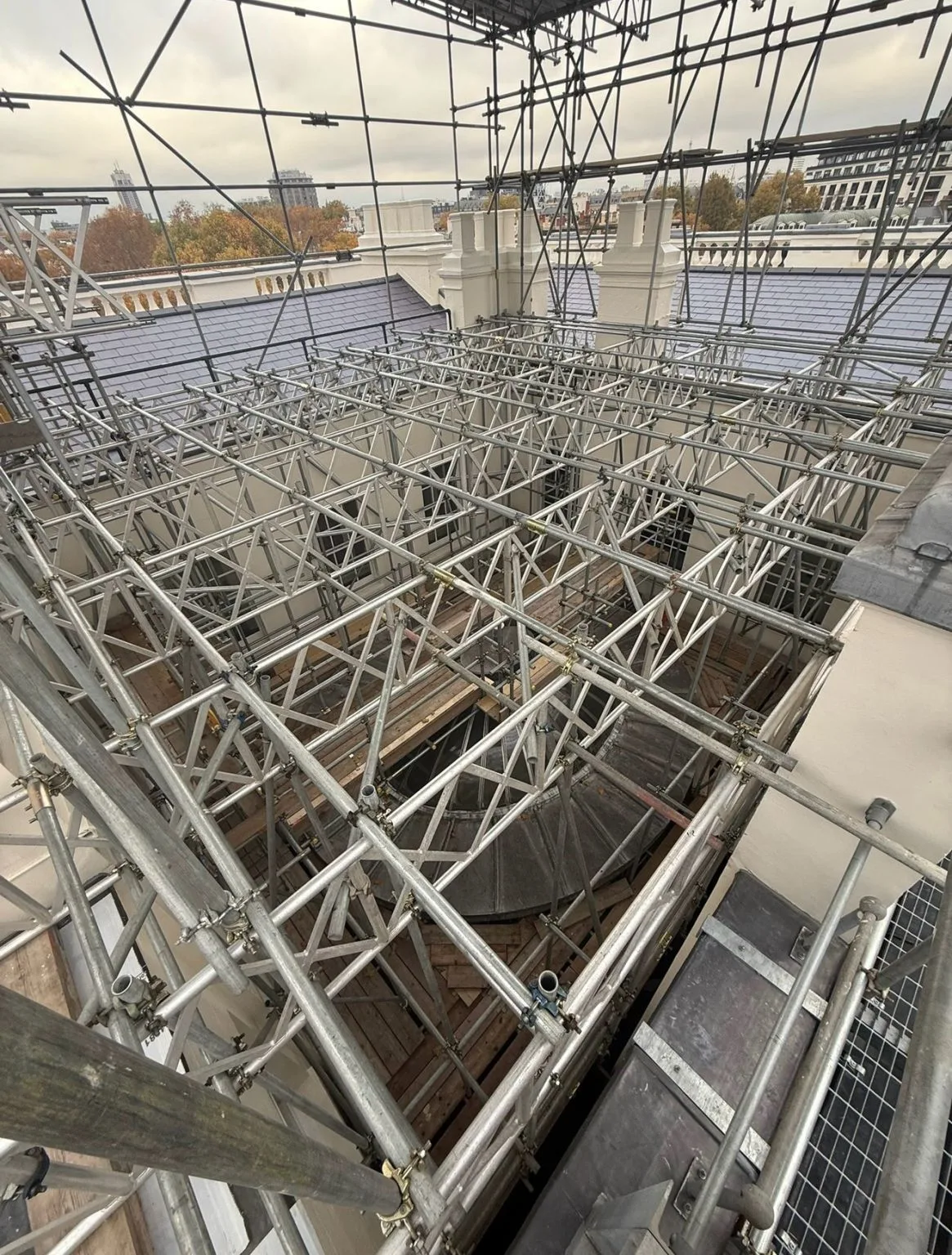
At roof level, a temporary roof structure was designed spanning across the building void between chimney stacks and parapets. The roof comprised an extensive network of scaffold tube trusses providing a weatherproof working enclosure for the roofing strip and re-cover works. The entire scaffold package had to be erected around the building’s operational schedule, with Wellington Site Security providing overnight protection for the works.
What Node Delivered
Full scaffold design combining gantry, hanging scaffold and temporary roof into a single coordinated package for Seaford House in the West End. 2D construction drawings, 3D model and structural calculations issued to programme, resolving the interface between three scaffold systems within the constraints of a tree-lined heritage setting and an operational heritage building.